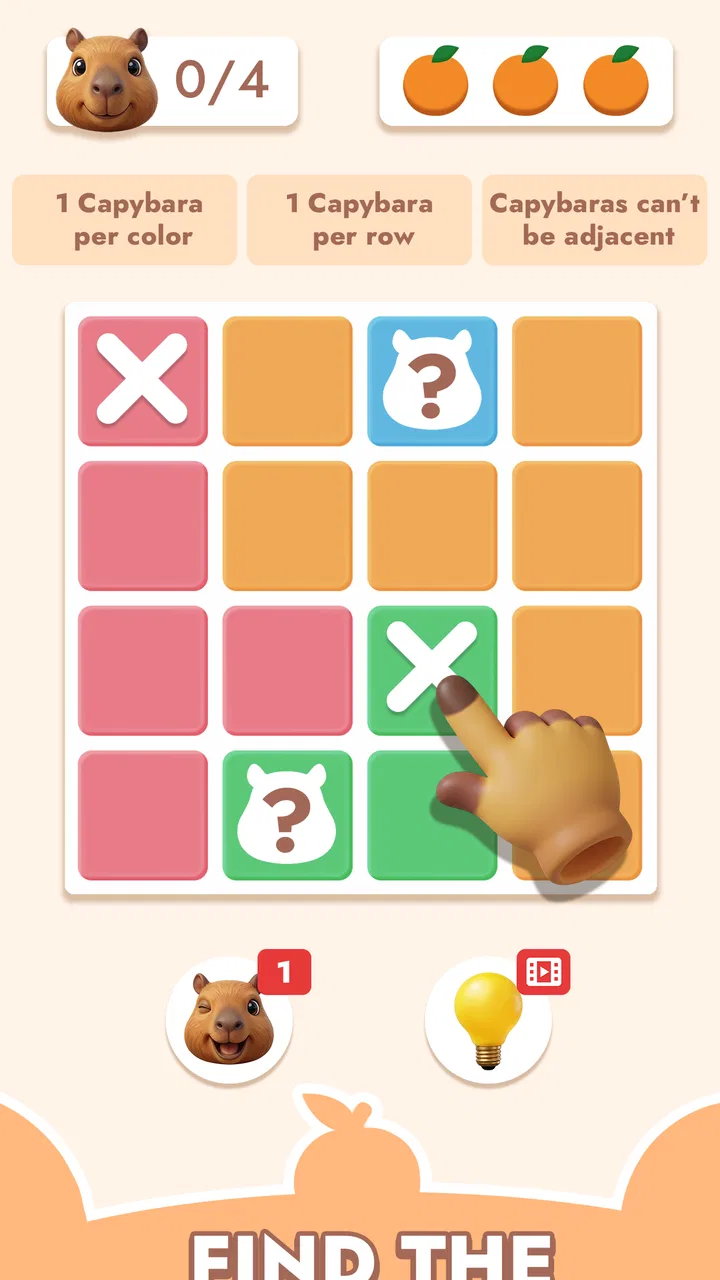
Capydoku
- 3.4
- Rating
- 10.00K
- Installs
- Free
- Price

 Analysis by App-foxy
I approached Capydoku expecting a gentle variation on sudoku, but its central idea gives the familiar puzzle a more playful purpose: while solving each grid, I also look for hidden capybaras. That small discovery layer changes the mood of the game. Instead of treating every puzzle as a bare logic exercise, I found myself paying attention to the board as a whole and enjoying the search as much as the solution.
It is a free strategy game from Tripledot Studios Limited, aimed at Everyone, and it runs on Android devices using version 6.0 or later. The current release is 1.01.01. Its average rating is 3.4 from around thirty ratings, with eight written reviews, and it has passed ten thousand installs. Those figures suggest a small, early audience rather than an established puzzle giant, so I see this as a focused experience for people curious about its capybara theme, not as a replacement for every sudoku app.
Why the hidden-capybara idea matters
The strongest verified capability here is the combination of cozy sudoku-style solving and hidden-object discovery. In a traditional sudoku app, the reward is usually the completed grid itself. Here, the puzzle has a second visual goal. That gives a simple logic routine a little more personality and makes the act of scanning the board feel meaningful rather than incidental.
You May Also Like

 AccuWeather: Weather Radar
AccuWeather Review: A Quick, Clear Forecast for Everyday Decisions
For everyday plans, the best forecast is the one you can understand quickly. AccuWeather makes rain timing, radar, and local conditions easy to act on, with a few trade-offs.

 Hill Climb Racing
Why Hill Climb Racing Still Turns Crashes Into One More Run
A tiny car, a bumpy hill and one more upgrade: Hill Climb Racing keeps resurfacing because its simple chaos makes every near-miss feel personal.

 AliExpress - Shopping App
AliExpress Makes Global Shopping Feel Personal, but Shoppers Bear the Risk
AliExpress turns a global marketplace into a pocket-sized discovery engine. Its reach is useful, its shopping loop compelling, and its trade-offs easy to miss.

 Lords Mobile: Kingdom Wars
Lords Mobile Is a Kingdom-Building Routine, Not a Quick Match
A case-by-case verdict on the building, battles, device demands, and social commitments that make Lords Mobile rewarding for some players and exhausting for others.

 PDF Scanner app - TapScanner
TapScanner Makes Paperwork Easier to Capture, Check, and Share
TapScanner makes scanning with a phone feel less like a rescue operation and more like a dependable step in getting work done. Its capture tools are useful, though not flawless.

 Block Blast!
 Shows How Much a Puzzle Game Can Leave Out
A quiet grid game shows why puzzle players increasingly value instant clarity, repeatable skill and low-pressure play—and where the genre still needs to catch up.
More From Our News Desk
View All News


I especially liked how this changes the pace. Sudoku normally encourages a narrow focus: choose a row, column, or box, eliminate possibilities, and repeat. The capybara hunt invites me to occasionally step back and inspect what is on screen. That interruption is useful when I am stuck, because it gives my attention somewhere else to go without abandoning the puzzle completely.
The hidden-cap ybara search is not just decoration; it changes how I use the board. I am more likely to pause after a difficult deduction, check the wider layout, and return to the numbers with a fresher eye. For short sessions, that makes the game feel less demanding than a serious sudoku trainer while still preserving the satisfaction of logical progress.
There is also a clear emotional difference between this and a plain number grid. A mistake in a conventional puzzle can feel like a small failure of concentration. The cozy presentation softens that feeling. I still want to solve the puzzle correctly, but the capybara theme makes the session feel more like a relaxed search than a test.
How the puzzle loop feels in practice
The basic rhythm is easy to understand. I work through a sudoku-style grid, use familiar logic to narrow down placements, and keep an eye out for the concealed capybaras. The game therefore asks for two kinds of attention: structured reasoning for the numbers and casual observation for the hidden character.
That combination works best when I resist rushing. If I fill cells too quickly, I focus only on completing the grid and can miss the visual charm that distinguishes this game. My preferred approach is to solve a few obvious placements, scan the surrounding area, then continue with the more involved deductions. It feels natural and avoids turning the hidden-object element into a separate chore.
A useful habit is to treat the capybara search as a reset between logical steps. When I have exhausted the obvious candidates in a row or box, I look across the board before forcing a guess. This does not magically solve a difficult position, but it prevents the familiar sudoku mistake of making an impulsive placement simply because progress has slowed.
The reverse is helpful too. If I become absorbed in searching, I return to the numerical structure by checking what each region still needs. The two activities balance one another. The numbers give the session its mental substance, while the hidden animals keep the presentation from becoming austere.
Because the game is categorized as strategy, I would not describe it as a pure hidden-object title. The capybaras add atmosphere and an extra reason to inspect the board, but the core appeal remains the sudoku-style reasoning. Someone looking for a long-form visual search game may find the number logic more prominent than expected. Someone who already enjoys sudoku but wants a warmer presentation is more likely to appreciate the balance.
A realistic everyday session
I can easily see using this during a short break when I want something more engaging than scrolling but less intense than a competitive game. I might begin a puzzle while waiting for an appointment, solve the straightforward cells, and pause when my attention is called elsewhere. The hidden-cap ybara angle makes that interruption feel less disruptive because I can return by scanning the board and reorienting myself.
It also suits a quiet evening routine. Rather than chasing a score or competing with other players, I can focus on one grid and enjoy the small satisfaction of noticing something tucked into the design. That is a meaningful distinction for anyone who finds leaderboard-driven puzzle apps tiring.
For a family setting, the Everyone rating makes the theme approachable across ages. I would still expect the sudoku-style logic to be easier for people who already understand the basic rules, but the capybara search gives a younger or less experienced player a visual reason to stay interested while learning. It can turn a solitary number puzzle into something two people can discuss together: one person checks the logic, the other looks more closely at the scene.
On a phone, the concept is particularly suitable for short attention windows. A sudoku grid is naturally compact, and the hidden visual detail gives me a reason to look carefully instead of tapping through mechanically. I would not choose it for a long commute if I wanted a broad campaign or a constantly changing challenge structure, but it fits the “one calm puzzle at a time” use case very well.
The tradeoff between comfort and depth
The same simplicity that makes the game welcoming may limit its appeal for experienced sudoku players. If I want advanced solving techniques, extensive customization, detailed statistics, or a serious training environment, a dedicated sudoku app is probably the better choice. Capydoku’s identity comes from combining logic with a cozy search, not from presenting sudoku as a technical discipline.
That means the hidden capybaras need to feel worthwhile. If I ignore them, I am left with a more familiar puzzle format and less of the personality that makes this title distinctive. My advice is to play it as intended: slow down enough to inspect the board. The game’s charm is easy to miss if I treat it as a standard solver and tap only for numerical efficiency.
There is another tradeoff in the dual-focus design. Some players may find the visual search relaxing, while others may see it as a distraction from logic. If I am trying to complete a puzzle quickly, looking for concealed animals can feel like an unnecessary detour. If I am using the game to unwind, that same detour is the point. The right choice depends on whether I value speed or atmosphere in a puzzle session.
The rating of 3.4 indicates a mixed early reception, and I would keep that in mind rather than assuming the game will suit everyone. With only a modest number of ratings and reviews, I would not treat the score as a definitive judgment of quality. Still, it reinforces my own conclusion: this is a niche presentation built around a specific mood, and its success depends heavily on whether that mood appeals to you.
I also would not recommend it to someone seeking a broad strategy game with resource management, tactical battles, or a large progression system. The strategy here is intimate and puzzle-based. Its challenge comes from interpreting a grid and noticing concealed details, not from managing a growing collection of units or making long-term campaign decisions.
Small techniques that make the concept work better
My first practical tip is to separate solving and searching without completely isolating them. I solve the obvious numerical moves first, then use the resulting open space as a visual checkpoint. This keeps the hidden-object element from slowing every single move while still giving it a regular place in the session.
Second, I avoid searching only around the cells I have just changed. That habit is too narrow for a game built around hidden details. After finishing a region, I scan the entire visible board, especially areas I have been ignoring because they contain no difficult deductions. The less “important” part of the grid may be exactly where my attention is most relaxed.
Third, I use the capybara hunt as a reason not to guess. In ordinary sudoku, a stuck moment can tempt me to place a number based on instinct. Here, I have a constructive alternative: pause, inspect the board, and then revisit the constraints. Even when the visual search does not reveal anything immediately, the pause often helps me see a missing relationship between a row, column, and box.
Finally, I would not judge a session only by whether I finish quickly. The game’s appeal is closer to a mindful puzzle break than a speedrun. A slower completion with careful observation is more satisfying than mechanically filling the grid and overlooking the hidden character that gives the title its identity.
Who should download it, and who should choose something else
I think Capydoku is best for casual sudoku fans who want a softer, more characterful presentation. It is also a good fit for players who enjoy hidden-object details but do not necessarily want a dedicated seek-and-find game. The two activities support each other without requiring a complicated ruleset.
It may appeal to parents looking for an approachable puzzle concept, though the logic portion can still require patience. The Everyone age rating makes the subject matter broadly accessible, but accessibility of theme is not the same as ease of solving. A child unfamiliar with sudoku may need guidance with the number rules before the capybara search becomes enjoyable on its own.
I would skip it if my priority were deep sudoku analysis, competitive timing, or a large set of strategic systems. I would also skip it if I dislike switching between a logic task and a visual observation task. In those cases, a focused sudoku tool or a dedicated hidden-object game would provide a cleaner experience.
For most other players, the free price makes trying it straightforward. The real question is not cost but fit: do I want a calm puzzle where discovery shares the spotlight with deduction? If yes, the concept is clear enough to justify a download, particularly on an Android device running version 6.0 or newer.
My overall impression
After spending time with it, I see Capydoku as a small, focused strategy game with one memorable idea. The hidden capybaras give sudoku-style puzzles a reason to be observed rather than merely completed, and that changes the emotional texture of each session. I enjoyed it most when I played slowly, treated the search as part of the puzzle, and allowed myself to pause instead of chasing efficiency.
It is not the right recommendation for a hardcore sudoku specialist or anyone expecting a full-scale strategy experience. Its strengths are gentleness, visual curiosity, and an approachable structure. Its limitation is that the same narrow focus may leave advanced players wanting more depth or customization.
For a friend who wanted a free, family-friendly puzzle with a cozy twist, I would recommend giving it a try. I would explain that the numbers are only half of the experience: the real pleasure comes from solving thoughtfully and then noticing the capybaras that reward a closer look. That combination is modest, but it gives this release from Tripledot Studios Limited a personality that a plain sudoku grid would not have.
FAQs for Capydoku
01What is Capydoku?
Capydoku is a Sudoku-style puzzle game that combines traditional number-placement logic with a friendly capybara-themed presentation. Players complete grids by placing the correct numbers without repeating them in rows, columns, or designated sections. Its appeal comes from offering a familiar brain-training format in a more relaxed and playful package, making it suitable for both casual players and regular puzzle fans.
02How does Capydoku gameplay work?
The main gameplay follows the basic rules of Sudoku: each empty cell must be filled with a number that does not already appear in its row, column, or smaller grid. You solve puzzles by analyzing possibilities, identifying guaranteed placements, and gradually completing the board. Depending on the version and difficulty selected, the game may also provide hints, notes, or other tools to support learning.
03Is Capydoku suitable for beginners?
Yes, Capydoku can be a good choice for beginners, especially if they are new to Sudoku or want a less intimidating way to practice. Easier puzzles usually introduce the rules gradually and allow players to build confidence before attempting more complex boards. However, users should still expect to think carefully, since success depends on logic rather than random guessing.
04Does Capydoku require an internet connection?
Capydoku’s offline availability can depend on the specific release and platform version, so it is worth checking the app-store description before downloading. Puzzle games often allow the core boards to be played without a constant connection, while advertisements, updates, cloud features, or optional online content may require internet access. Downloading the app and checking its settings is the safest way to confirm.
05Is Capydoku free to download and play?
Capydoku may be available as a free download, but the exact monetization model can vary between Android and iOS versions. A free app may include advertisements, optional purchases, extra puzzle packs, or other premium features. Before installing, review the store listing for pricing details, in-app purchase information, and supported devices so you know what the free version includes.
Pros
- Simple rules make Capydoku easy to learn for new players.
- Short rounds fit well into quick breaks or daily play.
- Clean interface keeps attention on the puzzle board.
- Helpful feedback makes mistakes easier to identify.
- Works well as a relaxing alternative to standard Sudoku.
Cons
- Limited variety may make the experience feel repetitive over time.
- Some puzzles can become frustrating without stronger guidance options.
- Players seeking competitive features may miss rankings or tournaments.
- The minimalist presentation may feel too plain for some users.
- Difficulty progression may not satisfy experienced Sudoku players.

Capydoku
Gallery